Showing posts with label Legs. Show all posts

Monday, May 11, 2015

LEG EXERCISE: LEG PRESS (II)

Leg Press. Part (II). Recommendations and Mistakes.


    Welcome to the Blog again friends, today we will speak on about the recommendations of accomplishment of this exercise to the different sectors of population, and about the most typical mistakes that the sportsmen commit in this exercise. 


  • RECOMMENDATIONS:


    As already was said in the previous post, the exercise of "Leg Press ", it is a perfect exercise( for the beginners of the world of the Fitness, since it offers a valid alternative, to the exerciseof the "Squat", needing less muscular commitment of the stabilizing zone of the trunk, and a minor level of tenchique. With the passage of time it is possible to progress from this exercise, towards to the Squat. In addition this exercise  this one indicated for persons with problems of back, which could not realize the "Squat" since the vertebrae are not submitted to a vertical excessive pressure. 

Sunday, May 10, 2015

LEG EXERCISE: LEG PRESS (I)

Leg Press. Part (I). Tecnhique. 


    Hello friends today we are going to explain the exercise of press of legs. This exercise presents many technical similarities with the sentadillas, though it does not need of an excessive training of base for its  accomplishment and its technology is less complex. 

    During the accomplishment of this exercise  we work principally the gluteus maximus and the cuádriceps, and in addition, muscles of the hamstring, adductors and glutes medius happen.


Tuesday, May 5, 2015

LEG EXERCISE: SQUAT (III)

Part III - Video - analysis of the execution of Squat.


 Third part of the publications dedicated to Squat.


    We leave you the video that the TFEteam has prepared with the aim to show with visual form as to realize of correct  form the execution of this exercise , from the point of view of the sport - health.


Wednesday, April 29, 2015

Power Exercise: Snatch(III)

Part III - Video - analysis of the execution of Snatch.


Third part of the publications dedicated to Snatch


We leave you the video that the TFEteam has prepared with the aim to show with visual form as to realize of correct form the execution of this exercise, from the point of view of the sport - health.


And we show you a pdf in order that you could download this information about the skill of execution.


Bibliography:
- Baechle T & Earle R. (2007). Principios del entrenamiento de la Fuerza y del Acondicionamiento Físico.
- J.E.Quiroga Díaz(2008). La técnica de los ejercicios de fuerza.


                   -----------------------------------------------------------------------------

Tuesday, April 28, 2015

Power exercise: Snatch(II)

 Power exercise: Snatch(II)

       Second part of technique of exercise


       Upward phase movement: the second pull
  • Explosive extension of the knees and the hips and flexion to plant of the ankles.
  • To support the bar surrounds or in touch with the previous face of the thighs.
  • To support the bar so near the body as is possible.
  • To keep the straight back, the elbows orientated towards out and the head on line with the vertebral column.
  • To support the shoulders on the bar and the extended elbows the major possible time.
  •  When the joints of the low train reach the complete extension, the shoulders are shrunk rapidly up, but without flex the elbows still
  • In the moment in which the shoulders reach his maximum increase, flex the elbows to start placing the body under the bar.
  • To continue pulling the arms so highly and so much time as be possible.
  • Due to the explosive nature of this phase, the torso is, the head lightly inclined backward and the feet can lose contact with the soil.

       Upward phase movement: captures
  • As soon as the low train has spread completely and the bar has reached almost his maximum height, to put the body under the bar and to rotate the hands around and below the bar.
  • Simultaneously, flex the hips and the knees staying in a position of a quarter of squat.

       To capture the bar with:
•The totally widespread elbows;
•The raised and tense trunk;
•The head in neutral position;
•The whole surface of the feet in touch with the soil; and
•The bar lightly behind the head.
•To extend the hips and the knees to adopt a totally raised position.
•To stabilize the bar over the head.
  • Updown phase  movement
  • To lower the bar by means of the gradual reduction of the muscular tension of the shoulders to allow a decrease controlled of the bar up to the thighs.
  • Flex simultaneously the hips and the knees to muffle the impact of the bar in the thighs.
  • Flex the knees and the hips with the totally widespread elbows until the bar touches the soil.

Bibliography:
 -Extraído de Baechle T & Earle R. (2007). Principios del entrenamiento de la Fuerza y del Acondicionamiento Físico. Ed. Médica Panamericana


                                ---------------------------------------------------------------------

Monday, April 27, 2015

DEAD LIFT

"DEAD LIFT"

Hello friends, today we have a new publication on an exercise about which we have to speak for his great importance in the development of the force, it is a very complete exercise that helps us to gain force of a significant form, and we are speaking about the exercise “dead weight”.

This exercise is very important in any routine and helps us to gain force, is a very complete exercise, but if there is not realized the technical execution of a correct form it can manage to produce serious injuries, since it is an exercise in which normally for his development they can raise big quantities of weight.

The muscular implied groups are the following ones:

            - Major Glúteo.
            - Isquiotibiales.
            - Combine thorny muscles.


Later we are going to explain the technical execution of the exercise:

Initial Position:

Of foot with the feet separated to the width of the shoulders, we hold a bar ahead of the thighs and the hands placed to the width of the shoulders, also we can use you dumbbell.

Downward movement

We lower the trunk realizing the movement of hip, it is important not to bend the back, the back always must be straight, and the knees little flexed, the hands must go down a bit below the knees.

Upwards movement

From the previous position, we raise the trunk realizing the movement of hip, and we return to the initial position without stretching completely the knees.

Advices:

            - Not to bend the back.
            - Not to stretch completely the knees.
            - Not to come up to the soil.
            - Not flexed in excess the knees.
            - To realize the exercise to a controlled speed.

Bibliography:


Sunday, April 26, 2015

Power exercise: Snatch (I)

Power exercise: Snatch (I)


       Hello friends, today they let's sense beforehand the third exercise of power, which is an exercise very known inside the world of the fitness, therefore today we are going to speak about the Sudden departure also called Snacht. 


       The aim of this exercise consists of pulling the bar of energetic and rapid form from the soil up to placing it over the head, with the totally extended shoulders everything in a movement. Though the rising movement consists of multiple phases, the rising movement of the bar takes place of constant form without interruption.


       In the today post we will speak about the initial position that it is necessary to adopt, besides the first two as rising phases since it are the first pull and the transition. And in the following post on this one exercises we will speak about the second pull and about the capture.


       Analysis of the execution of the Snatch

       The first step is to place of foot with the feet separated to the width of the hips and that of the shoulders. In necessary flex the hips and the knees and it is necessary to take the bar using a closed grasp, in overhand grip.


       The following step is to extend the elbows totally and placed the body of the following way:

  • Straight back or lightly arched,
  • Relaxed trapezes and lightly stuck-up,
  • I pay towards out and up,
  • Escápulas retiring(unsociable),
  • Head on line with the vertebral column 
  • Heels in touch with the soil,
  • Shoulders on or lightly ahead of the bar and
  • Sight centred directly to the front or lightly up.

       Upward phase movement: the first pull
  • To raise the bar of the soil extending energetically the hips and the knees.
  • To prevent the hips from rising before that the shoulders.
  • To support the straight back.
  • To support the totally widespread elbows, the head aligned with the vertebral column, and the shoulders on or lightly ahead of the bar.
  • On having raised the bar, to support it so near the blackheads as is possible.

       Upward phase movement (scoop)
  • On having raised the bar over the knees, having moved the hips forward and having turned to flex lightly the knees to place the thighs against the bar and the knees below the bar.
  • To support the straight back or lightly arched, the elbows totally widespread and orientated towards out, and the head on line with the vertebral column.

Bibliogrphy:
-Extraído de Baechle T & Earle R. (2007). Principios del entrenamiento de la Fuerza y del Acondicionamiento Físico. Ed. Médica Panamericana.


                          ------------------------------------------------------------------------------- 

LEGS EXERCISES: "SQUAT". PART (I)


Squat. Basic Movement. Part (I).


     Hello everybody, today we are going to dedicate our entry to one of the exercises most used in the GYM, and that forms a part of any routine of training.  We are speaking about the Squat.

    The Squat is a complete exercise, which implies principally like muscles agonists "the quadriceps" (previous, vast external, vast internal rectum, crural) and the gluteus maximus, and as muscles synergists of the exercise the hamstring. In addition there is fundametal the activation of certain muscles that fulfill a stabilizing function (they help to keep the correct position) since are the spinal erectors and the transverse abdominal.

    In addition this exercise can be realized without any type of material using only our own corporal weight, or with overload using you dumbbell or barbell.


Phase of descending movement.

- To place the feet of parallel form between them, with a separation similar to that of the width of the shoulders and with the fingers orientated lightly towards out.

- Respecting the described position of the feet previously, to begin to realize a flexion of knees until the thigh remains parallel to the soil (90 º of flexion). It is said commonly that: " we have to have the sensation that we are going to sit down in a chair ".

* Important to support during the accomplishment of this phase to support the straight back, to keep the elbows high, to keep the heels in touch with the soil and the mentally ill knees on our feet, without exceeding in excess the tops of the same ones.

Phase of ascending movement.

- To extend the hip and the knees to the same speed.

- To keep the angle constant between the trunk and the soil.

* Important to support the straight back (avoiding the flexion of the trunk ahead or to round the back), to keep the elbows high, to keep the heels in touch with the soil and the mentally ill knees on our feet.

Saturday, April 25, 2015

Elevations of heels of foot with machine

"Elevations of heels of foot with machine"

     Hello friends, today we have a new publication that is related by one of our last post.

     We try to complement and to complete an exercise that normally we realize without bearing in mind if we are developing our musculature to hundred for hundred or only we are developing it in a small percentage, are speaking about the exercise " elevations of heels of foot with machine ", a very effective exercise to develop the musculature of our twins, but we must go beyond during the execution of the exercise and think about what form we are working our twins.

     This exercise normally is realized by the top of the feet looking towards ahead, of this form we are working our gastrocnemius, that is to say, our twins, but now we should do a question to us, are we working our twins of a complete form?


     We must remember that the twin is formed by two portions, the internal gastrocnemio and gastrocnemio externally and that depending on the direction of our feet during the execution of the exercise both portions do not work equally, with this we want to say that we are developing or affecting more the work in a portion or other one.


     Position of the feet during the execution of the exercise:

     If we try to work or to affect more in the internal gastrocnemio, we must place the tops of the feet appearing lightly towards out, that is to say, as if we were forming one "v" with our feet, of this form we will affect more on the internal portion of the twin.

     If on the contrary we want to imply more the external portion of the twin, at the time we will have to place the top of our feet lightly inward.

     Of this form we are working of a more specific form our twins, as normally in a gymnasium the sportsmen do it for example, with the biceps in his long portion and his portion it cuts.

     Bibliography:

Friday, April 24, 2015

Power exercise: Power clean (III)

Part III - Video - analysis of the execution of Power clean

       Third part of the publications dedicated to Power Clean


       We leave you the video that the TFEteam has prepared with the aim to show with visual form as to realize of correct form the execution of this exercise , from the point of view of the sport - health.


Bibliogrhapy:

-Baechle T & Earle R. (2007). Principios del entrenamiento de la Fuerza y del Acondicionamiento Físico.


Thursday, April 23, 2015

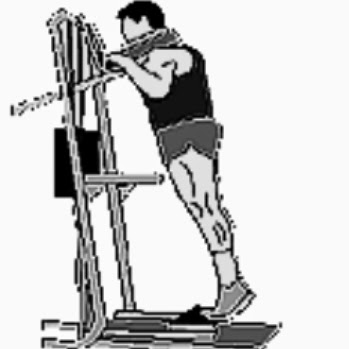
Elevations of heels of foot with machine

"Elevations of heels of foot with machine"

Hello friends, today we have a new publication in which we go away to centring on a musculature that many sportsmen and persons who come often to a room of musculación we observe that they do not affect in the work of these muscles, refer to the twins.

Normally the low train is a part forgotten in the rooms of musculación and even more the twins, this produces decompensations in our body and overloads that act of negative form in our body, a top very developed and worn out train that it(he) must be supported for a low very little developed train and in some cases almost not worked.

The musculature involved in this exercise is the following one:

         - External Twin.
         - Internal Twin.
         - Sóleos.

Later we are going to explain the technical execution of the exercise:

Initial Position

Of foot with the feet to the width of the shoulders, knees lightly flexionadas and straight back, the ink pads must be supported in the shoulders and the top of the feet in the platform.

Exercise:

We raise the heels realizing an extension of feet or flexion to plant, realizing only the movement of feet, without helping ourselves with the rest of the body.

It is important to support a correct position about not getting hurt, since we are mobilizing weight.

Advices:

         - To realize the exercise to a controlled speed.
         - To realize the alone movement with the feet, without involving the rest of the body.
         - To support a correct position about avoiding to get hurt for the weight.
         - To avoid to realize rebounds on having finished the movement or to realize a major extension.

Bibliography:

Tuesday, April 21, 2015

Power Exercise: Power Clean(II)

Power Clean(II) 


      Rising movement phase: the second pull
  • Explosive extension of the knees and the hips and flexion to plant of the ankles.
  • To support the bar surrounds or in touch with the previous face of the thighs.
  • To support the bar so near the body as is possible.
  • To keep the straight back, the elbows orientated towards out and the head on line with the vertebral column.
  • To support the shoulders on the bar and the extended elbows the major possible time.
  • When the joints of the low train reach the complete extension, the shoulders are shrunk rapidly up, but without flex the elbows still.
  • In the moment in which the shoulders reach his maximum elevation flex the elbows to start placing the body under the bar.
  • To continue pulling the arms so highly as you can.

         Rising movemen phaset:  captures
  • As soon as the low train has spread completely and the bar has reached almost his maximum height, to put the body under the bar and to rotate the arms around and below the bar.
  • Simultaneously, flex the hips and the knees staying in a position of a quarter of squat.
  • As soon as the arms are under the bar, to raise the elbows to place the arms in parallel to the soil. To place the bar on the clavicles and the previous portion of the deltoids.

       To capture the bar with:
  1. The raised and tense trunk,
  2. The head in neutral position and
  3. The plants(floors) of the feet rested(relied) in its entirety on the soil.
  4. To extend the hips and the knees to adopt a totally raised position.

         Descending movement phase
  • To lower the bar by means of the gradual reduction of the muscular tension of the arms to allow a decrease controlled of the bar up to the thighs.
  • Flex simultaneously the hips and the knees to muffle the impact of the bar in the thighs.
  • Flex the knees and the hips with the totally widespread elbows until the bar touches the soil.
Bibliography:
-Extraído de Baechle T & Earle R. (2007). Principios del entrenamiento de la Fuerza y del Acondicionamiento Físico. Ed. Médica Panamericana


                                      ----------------------------------------------------------------------------------------------------------------

Power Exercise: Power Clean(I)

Power Clean


       Hello friends, today we present you the second exercise of power, which is a very common exercise in those persons lovers of the fitness, it could not be another exercise that “Loaded” also called Power clean.

       In this exercise we depart a bit from the exercise previously explained of power of Push Press, but it is normal that the technical execution changes enough but it has things jointly. In the loaded one it consists of throwing(shooting) the bar of energetic and rapid form from the soil up to the shoulders, everything in the shape of the only movement.

       Though the rise consists of 4 phases, the rising movement of produces of constant form without interruption. For this motive in the first part of the Post of today we will speak about the initial position and about the first two rising phases. In following post we will speak about the second two phases and about the descending phase.

       Initial position
  • To place of foot with the feet separated to an intermediate distance between the width of the hips and that of the shoulders, with the fingers orientated lightly towards out.
  • Flex the hips and the knees with the hips below the shoulders and to take the bar using a closed grasp, in overhand grip.
  • To place the hands in the bar with a separation lightly superior to that of the shoulders, externally of the knees, with the totally widespread elbows.
  • To support the whole floor of both feet in the soil and to place the bar to an approximate distance of 3 cm. Of the blackheads directly over the metatarsi.

       To place the body with:
  1. Straight back or lightly arched.
  2. Relaxed trapezes and lightly stuck-up.
  3. I pay towards out and up.
  4. Retiring scapuls.
  5. Head on line with the vertebral column or lightly hyperwidespread,
  6. Shoulders on or lightly ahead of the bar and
  7. Sight centred directly to the front or lightly up.

        Movement up phase: the first pull
  • To raise the bar of the soil extending energetically the hips and the knees.
  • To keep the angle constant between the trunk and the soil.
  • To prevent the hips from rising before that the shoulders.
  • To support the straight back.
  • To support the totally widespread elbows, the head aligned with the vertebral column and the shoulders on or lightly ahead of the bar.
  • On having raised the bar, to support it so near the blackheads as is possible.
        Movement up phase: transition (scoop)

  • On having raised the bar over the knees, having moved the hips ahead(forward) and having turned to flexi lightly the knees to place the thighs against the bar and the knees below the bar.
  • To support the straight back or lightly arched, the elbows totally widespread and orientated towards out, and the head on line with the vertebral column.
Bibliography:
-Extraído de Baechle T & Earle R. (2007). Principios del entrenamiento de la Fuerza y del Acondicionamiento Físico. Ed. Médica Panamericana.


                    ---------------------------------------------------------------------------------------


Sunday, April 19, 2015

Power exercise: Push Press

Power exercise 


       In the next days we are going to speak about the exercises of power, where we are going to discover different exercises belonging to this group, today we are going to begin for that of extension of shoulders of foot, also known like (push press).

       This exercise consists of raising the bar of explosive form from the shoulders over the head. Though the movement consists of two phases, the movement of the bar up takes place of constant form without interruption.


       In this exercise there is necessary the fast extension of the hips and the knees that the bar accelerates from the shoulders, followed immediately of movements that take the bar to his final position over the head.

       Skill of the push press


      Initial position

  •  To take the bar using a grasp closed in over hand.
  •  The grasp must be lightly broader than the width of the shoulders.
  •  To place under the bar, the feet with a separation similar to that of the hips and parallel each other
  •  To place the bar supporting her on the previous portion of the deltoid and the clavicles
  • To extend the hips and the knees to extract the bar of the supports.
  •  To give a step for behind.
  •  To place the feet with a separation similar to that of the shoulders (or more separated) and the two to the same height with the fingers orientated lightly towards out.
  • All the subsequent repetitions begin from this position.

       Upward movement: bottom
  • Flex lightly the hips and the knees supporting the feet in the soil.
  • To support the raised trunk and the arms parallel to the soil.

       Upward movement: push


        To extend the hips and the knees of energetic and rapid form and then the elbows to raise the bar over the head.

        As soon as the bar is over the head, to establish a position with:
  • The totally widespread elbows
  • Tense and raised trunk
  • Head in neutral position
  • Sole rested totally on the soil 
  • Sweep lightly behind the head

       Updown  movement
  • To lower the bar by means of the gradual reduction of the muscular tension of the arms to allow the decrease controlled of the bar up to the shoulders.
  •  Flex simultaneously the hips and the knees to muffle the impact of the bar in the shoulders.

Bibliography:
- Extraído de Baechle T & Earle R. (2007). Principios del entrenamiento de la Fuerza y del Acondicionamiento Físico. Ed. Médica Panamericana.


                         ---------------------------------------------------------------------------------------------


       Ejercicios de potencia

       En los próximos días vamos a hablar de los ejercicios de potencia, donde vamos a descubrir diferentes ejercicios pertenecientes a este grupo, hoy vamos a comenzar por el de extensión de hombros de pie, también conocido como (push press).

       Este ejercicio consiste en elevar la barra de forma explosiva desde los hombros por encima de la cabeza. Aunque el movimiento consiste de dos fases, el movimiento de la barra hacia arriba se produce de forma continua sin interrupción.

       En este ejercicio es necesaria la rápida extensión de las caderas y las rodillas que acelera la barra desde los hombros, seguidos inmediatamente de movimientos que llevan la barra a su posición final por encima de la cabeza. 

       Técnica del push press

       Posición inicial

  • Tomar la barra utilizando un agarre cerrado en pronación.
  • El agarre debe ser ligeramente más ancho que la anchura de los hombros.
  • Colocarse debajo de la barra, los pies con una separación similar a la de las caderas y paralelos entre sí
  • Colocar la barra apoyándola sobre la porción anterior del deltoides y las clavículas.
  • Extender las caderas y las rodillas para sacar la barra de los soportes.
  • Dar un paso para atrás.
  •  Colocar los pies con una separación similar a la de los hombros (o más separados) y los dos a la misma altura con los dedos orientados ligeramente hacia afuera.
  •  Todas las repeticiones subsiguientes empiezan desde esta posición.

       Fase de movimiento ascendente: fondo
  • Flexionar ligeramente las caderas y las rodillas manteniendo los pies en el suelo.
  •  Mantener el tronco erguido y los brazos paralelos al suelo.

       Fase de movimiento ascendente: empuje


        Extender las caderas y las rodillas de forma enérgica y rápida y luego los codos para levantar la barra por encima de la cabeza.
        Una vez que la barra está por encima de la cabeza, establecer una posición con:
  •  Los codos totalmente extendidos
  •  Tronco tenso y erguido
  • Cabeza en posición neutra
  • Planta del pie apoyada totalmente en el suelo 
  •  Barra ligeramente detrás de la cabeza

       Fase de movimiento descendente
  • Bajar la barra mediante la reducción gradual de la tensión muscular de los brazos para permitir el descenso controlado de la barra hasta los hombros.
  •  Flexionar simultáneamente las caderas y las rodillas para amortiguar el impacto de la barra en los hombros.

 Bibliografía:
-Extraído de Baechle T & Earle R. (2007). Principios del entrenamiento de la Fuerza y del Acondicionamiento Físico. Ed. Médica Panamericana.